
Why so much nail care disappoints, the enzyme biology behind this one, and how a published 2004 paper shaped the way it's built.
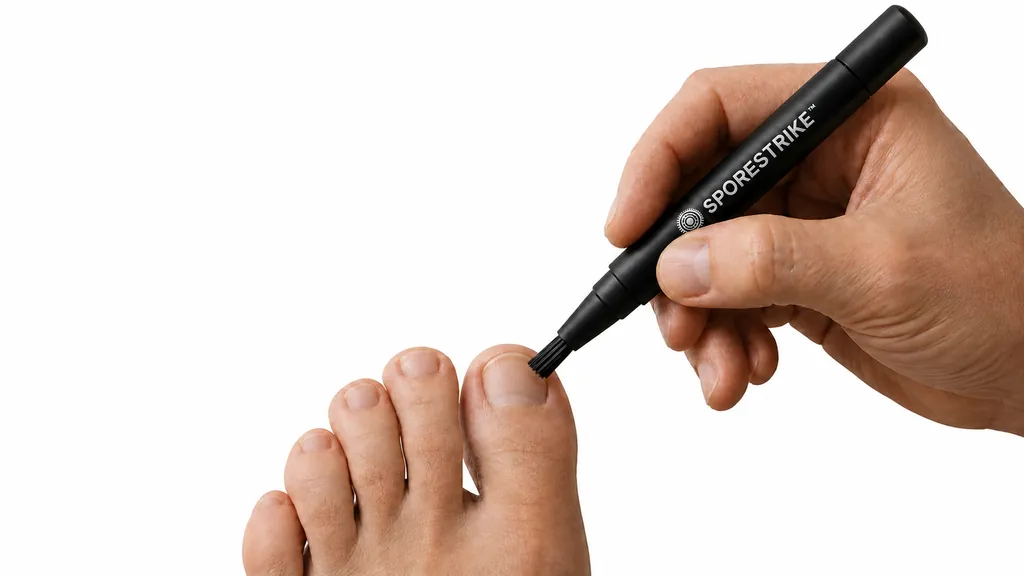
If you have worked through two or three nail products over a few years without the result you wanted, you were probably not using them wrong.
The nail plate is dense, layered keratin with no blood supply. Anything applied to the outside has to travel through that structure to reach anything underneath it. Most of a topical dose does not get there. That is an anatomy problem, not an ingredient problem, and it is why the category has the reputation it has.
It is also why the labelling looks the way it does. Under FDA OTC monograph M005, a topical drug in this category labelled for use on nails is considered misbranded unless it has been through a New Drug Application. So the products on that shelf are honest about their limits in the fine print, even when the packaging is not loud about it.
Sporestrike is not a drug and does not try to be one. It is a cosmetic nail and skin care serum, and this page is about the biology it is built from.
Most conventional topical actives work by interfering with how certain organisms build their cell membranes. There is a second, older mechanism: enzymes that break a cell wall down directly instead. That mechanism is enzymatic rather than chemical, and it has been used in agricultural biocontrol for decades.
The enzymes involved include chitinases, which digest chitin, and beta-glucosidases, which break down glucans, the other major structural component of the cell walls they act on. That is categorically different from how conventional topical actives work: those interfere with membrane construction, while this mechanism digests the wall directly.
This mechanism has been studied and published in peer-reviewed literature. The full citation, the organism involved, and an honest account of what that research does and does not establish are all on The Science.
An important limit on what that means. This is in vitro research establishing a mechanism. It is not a clinical trial of Sporestrike, no study has been run on Sporestrike, and we will not present it as one. What it establishes is that the biological principle the formulation draws on is real, published, and independently studied. That is a narrower claim than the category is used to hearing, and it is the one we can actually stand behind.
Translating that into something usable on a human nail is mostly a delivery problem, which is where the other two design decisions come from.
An activated charcoal substrate. Not a colourant. A porous scaffold that modulates pH and moisture at the application site, carries and slowly releases nutrients that support enzymatic activity, and holds the bioactives in close contact with keratinized tissue.
An oxygen-sealed applicator. Enzymes oxidise. An airless pen protects potency between uses and places a precise dose at the nail bed without waste or contamination.
Neither is a marketing flourish. They are both consequences of choosing a biological system over a synthesised chemical.
That's where Sporestrike Labs entered the picture.
Our formulation team spent two years translating this enzyme biology into a modern delivery system: a lightweight serum, carried on activated charcoal and housed in a precision pen applicator, that takes seconds to use.
By combining a Purified Enzyme Complex with concentrated botanical oils in exact ratios, we created something that didn't exist before:
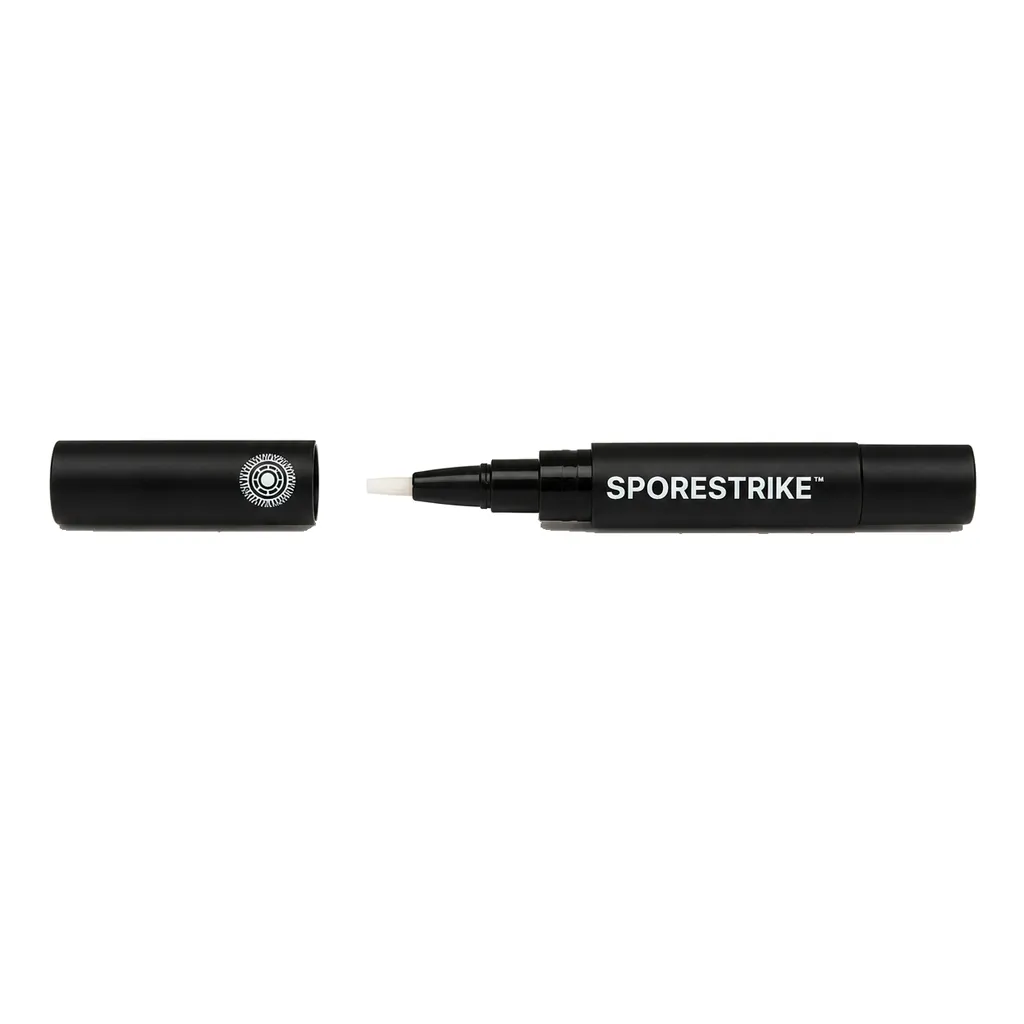
Every ingredient below is on the label. Nothing else is. Grape seed oil is the base; the enzyme complex and the activated charcoal are what make it Sporestrike.
Our proprietary complex, a purified set of enzymes, chitinases and beta-glucosidases among them. The reason the product exists.
Coconut-shell activated carbon. A porous carrier that holds the complex in contact with the nail. It is also why the serum is jet black.
The cold-pressed base oil. Light, fast-absorbing, and high in proanthocyanidins that support skin barrier integrity.
One of the most oxidatively stable plant oils known. Keeps the blend fresh from the first pass to the last.
Rich in ricinoleic acid. Conditions the nail and cuticle, and contributes to the serum's signature color.
Tea tree leaf oil, a botanical with a long record in nail care, and a trace of shea oil to condition the surrounding skin.
Reviews below are pulled directly from our Etsy shop, unedited.
Clean, dry nails. Ideally right after a shower or wash, and before sleep.
Brush a thin layer over the nail bed, under the free edge and around the cuticle, like applying nail polish.
Do not rinse. Let it absorb overnight; socks help it stay put.
Once a day, consistently. Nails grow slowly — think months, not days.
No filing. No soaking. No mess.
